Business of Home: A showhouse that’s creating an enduring legacy for BIPOC designers

Showhouses are perhaps the closest that interior design gets to performance. It’s an opportunity for designers to indulge in their most extravagant ideas and flex their artistry in a way that working with clients doesn’t often allow. And, much like a buzzy gallery exhibit, there’s a short window to experience it in person before it’s over. By nature, a showhouse is a temporary spectacle. That’s one of the reasons why The Kaleidoscope Project, a new showhouse in Lenox, Massachusetts, is a unique concept: It’s built to last.

The Kaleidoscope Project doesn’t take place in a pristine new-build mansion, ready to hit the real estate market as soon as the showhouse ends. Instead, it inhabits the historic Cornell Inn, and once the showhouse is over, the newly designed rooms will welcome the Berkshires bed-and-breakfast’s guests for years to come.

Amy Lynn Schwartzbard, co-founder of The Kaleidoscope Project and a Lenox local, had been interested in starting a showhouse in the community in 2020 but was stymied by the pandemic. The delay worked out in the long run, as the timing aligned with the centuries-old Cornell Inn passing to new owners who were planning to renovate the property. “I don’t think the owner knew quite what he was agreeing to when he said yes to our idea,” jokes Schwartzbard, who is also the principal of the hospitality-focused multiline Life Designs Group. “He had never even heard of a showhouse, but he understood that it was a chance to do something unique.”

The enduring nature of the project is all the more significant given that only designers of color were tapped to work on it. Schwartzbard was deeply moved by the Black Lives Matter protests last summer and wanted to go into what she calls “reaction mode.”

“I got very upset about the inequality in our industry,” she says. “I wanted to do something that could help expose and promote BIPOC [Black, Indigenous, and people of color] designers in this industry, and I wanted to do it in my own community.” Schwartzbard reached out to two industry friends in New York—designer Patti Carpenter and Liz Nightingale, former vice president, director of marketing at the Decoration & Design Building—and brought them on board as co-founders to help bring The Kaleidoscope Project to life.

Ultimately, 23 designers were invited to collaborate on the 34-room inn and carriage house. The owners agreed to give the designers complete creative control, but in order to make the property a bit more cohesive than a traditional showhouse, Carpenter, who is also an expert in trend and color forecasting, devised three color palettes that participating designers could use to guide their designs, ranging from a mix of cool blues to neutrals and earth-toned hues.

“At first, when I heard about the color palettes, the Type A designer in me was like, ‘Ugh, you’re going to tell me what to do?!’” says Nile Johnson, who designed one of the rooms. “But then I got it. They wanted to make sure there was a flow.” Johnson went with the more neutral of the options. “It worked wonderfully and it kept everyone in unison,” he says. “I don’t typically start with a color story and work from there, but with a showhouse where there really aren’t parameters and you have access to basically anything you want, it was nice to have that as a launchpad.”

Though the Cornell Inn has been well-maintained, it’s still nearly 250 years old and came with myriad challenges. “We couldn’t take down any walls or change any electrical wiring—meaning no light fixtures could be moved,” says Schwartzbard. “We had instances of the plaster on the walls just crumbling in our hands, and there were layers on layers of wallpaper that had to come off. If this had been a complete renovation, everything could have gone down to the bones, but we didn’t have the funds or the time. We only started construction in mid-January, so the entire project was completed in four months.”

The short timeline was compounded by COVID, which meant that all of the designers worked virtually. Many, like designer Purvi Padia, saw their room for the first time on install day a few weeks ago. “It’s the only project I’ve ever designed without having physically seen the space,” says Padia. “I worked off of photography, which was challenging enough, but then you realize that these aren’t modern floor plans—they were conceived in the late 1700s. Between the pandemic constraints, the historical constraints and the budget constraints, I’ve never been so nervous about a design in my life.”

The majority of the decorators who worked on the project are residential designers who waded into hospitality design for the first time. While they were allowed to accessorize however they pleased for the duration of the showhouse, much of those decorative items will be cleared away before the inn starts accepting guests. Similarly, any bedding the designers picked out will be switched out with a more uniform option at the end of the showhouse run.

Padia says the fact that the rooms will theoretically host hundreds of guests did have an impact on her aesthetic choices. “There’s a balance between making a hotel room feel homey and welcoming but not making it feel like you’re walking into someone else’s space or their vision of a relaxing room,” she explains. “I stuck to neutral tones with black and wood accents, wanting it to feel warm and easy.”
Read the full article.

Aguirre Design: The Interview with Purvi Padia

Purvi’s work can easily be described as having a modern style with a traditional twist.

We are thrilled to launch Portraits with the singularly talented Purvi Padia of Purvi Padia Design. Purvi established her interior design firm over a decade ago, through which she approaches design by blending classic and modern forms. Her creations and philanthropic work have been noted and featured in Vogue, Forbes, The New York Post, and a host of other wide-reaching publications.

For our inaugural interview, Purvi took time from her increasingly successful firm to discuss how she crossed from fashion and beauty, finding her calling as an interior designer and entrepreneur, her current projects, and how UNICEF is making a difference in the lives of hundreds of thousands of orphaned children.

What were you doing before starting in Interior Design?

I started my career in corporate design for beauty/ fashion brands. During my 8 years of work in the beauty / fashion industry, I learned countless lessons about design, project management, client relations and marketing. However, during those years, I always felt something was missing and that there had to be a way for me to feel even more professionally fulfilled. Since I was a little girl, entrepreneurship was a dream of mine; and while I loved fashion & beauty, I soon realized interiors were my true passion. So, I went back to school and got my degree in interior design. I launched my firm in 2009. Having my own company has been an unbelievable amount of work, but it has also taught me so much about what I’m capable of and has been hugely gratifying. Interior design has so many similarities to the beauty/ fashion world, but I love the added layer of intimacy that creating a home for a specific client allows.

Read the full article.

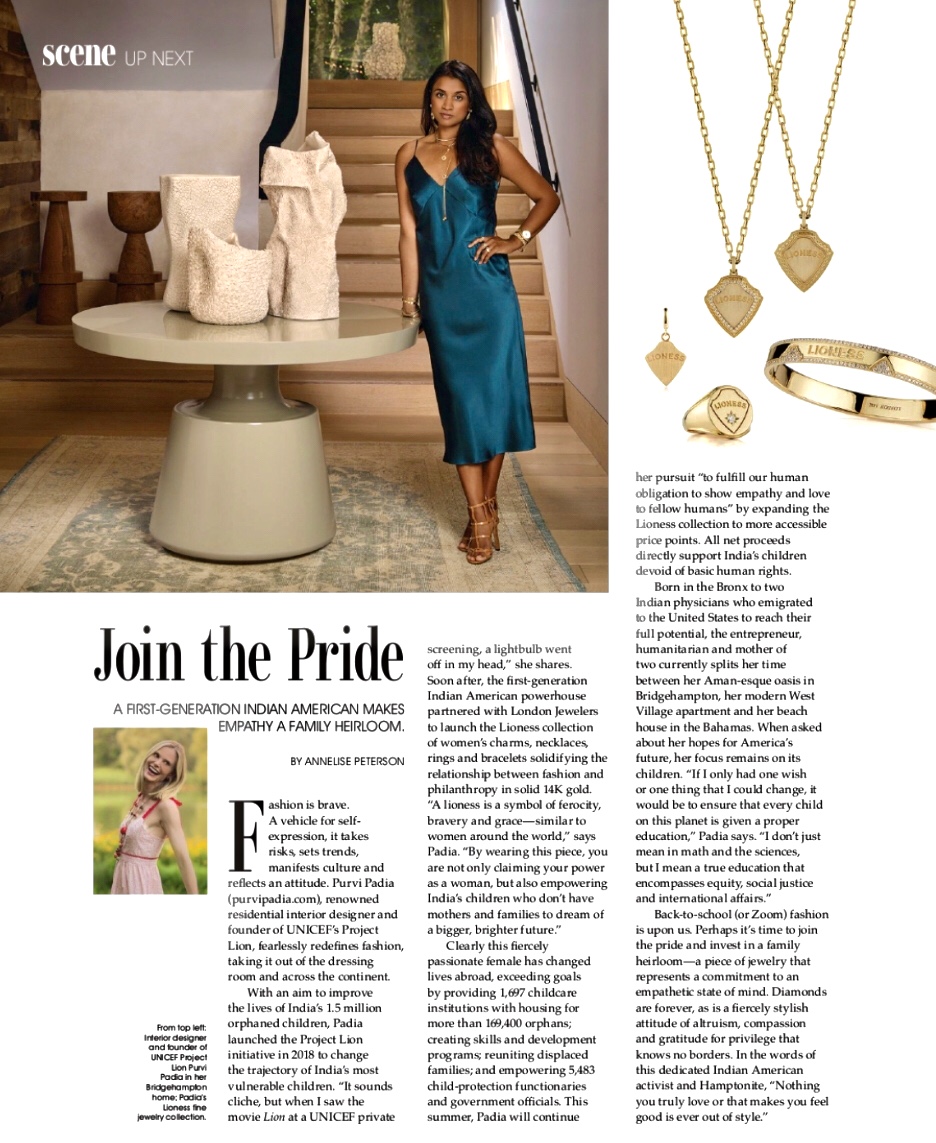
Hamptons: Join the Pride

A first-generation Indian American makes empathy a family heirloom.

Fashion is brave. A vehicle for self-expression, it takes risks, sets trends, manifests culture and reflects an attitude. Purvi Padia (purvipadia.com), renowned residential interior designer and founder of UNICEF’s Project Lion, fearlessly redefines fashion, taking it out of the dressing room and across the continent.

With an aim to improve the lives of India’s 1.5 million orphaned children, Padia launched the Project Lion initiative in 2018 to change the trajectory of India’s most vulnerable children.

Read the full article.

Manhattan Award Program: 2020 Best of Manhattan Award

Purvi Padia Design LLC Receives 2020 Best of Manhattan Award

Manhattan Award Program Honors the Achievement

Purvi Padia Design LLC has been selected for the 2020 Best of Manhattan Award in the Interior Designer category by the Manhattan Award Program.

Each year, the Manhattan Award Program identifies companies that we believe have achieved exceptional marketing success in their local community and business category. These are local companies that enhance the positive image of small business through service to their customers and our community. These exceptional companies help make the Manhattan area a great place to live, work and play.

Various sources of information were gathered and analyzed to choose the winners in each category. The 2020 Manhattan Award Program focuses on quality, not quantity. Winners are determined based on the information gathered both internally by the Manhattan Award Program and data provided by third parties.

About Manhattan Award Program

The Manhattan Award Program is an annual awards program honoring the achievements and accomplishments of local businesses throughout the Manhattan area. Recognition is given to those companies that have shown the ability to use their best practices and implemented programs to generate competitive advantages and long-term value.

The Manhattan Award Program was established to recognize the best of local businesses in our community. Our organization works exclusively with local business owners, trade groups, professional associations and other business advertising and marketing groups. Our mission is to recognize the small business community’s contributions to the U.S. economy.

Luxe: Gold List 2020 Honoree

Purvi Padia Design is a Gold List Honoree in Interior Design in Luxe Interiors + Design’s 2020 Gold List, a select guide to the Architects, Interior Designers, Home Builders and Landscape Architects whose projects were featured in the magazine.

See who made the list >

For over 10 years, Luxe Interiors + Design has been a premier magazine in the design industry.

New York Post: New Yorkers are re-designing their homes to host charity fundraisers

It seemed like a standard assignment for interior designer Purvi Padia: a 5,600-square-foot luxury loft in Tribeca, owned by a family with three small children. But the clients — both keen philanthropists — lobbed her an additional request: They wanted the common areas to do double duty, to function both as a cozy family hideaway and a workable venue for hosting benefits.

The ask didn’t faze Padia. She’s been fielding similar requests lately from wealthy New Yorkers across the city, who want to go beyond conventional entertaining to focus on opening up their homes for formal, charitable events.

“There is now a subset of my clients who ask me to design spaces with the intention of entertaining people they might not know that well,” she explains. Handily, that includes Padia herself, a fervent UNICEF supporter who has thrown bashes for the charity at her own home — where she has workshopped the techniques that she now applies to her clients’ spaces.

Click here to read the full article.

Luxe Interiors + Design Magazine: Resort Style

A designer assembles an all-star team to fulfill her vision of the perfect Bridgehampton retreat.

Long before land was secured or pen was put to paper, designer Purvi Padia and her husband, Harsh, knew what they wanted out of their dream house. They imagined pavilionstyle living, with a cohesive transition between inside and out. There would be a consistent materials palette, an open floor plan and ample space for both family and visiting friends. In short, they wanted something evocative of a resort, akin to the Amanyara in the Turks and Caicos. So once they found their just-right parcel, Padia conceived the abode’s interiors. “It was important for me that it was a home thoughtfully curated from beginning to end with a clear, concise concept,” she says.

View the full article.

Real Simple: 7 Retro Decor Trends Making a Major Comeback

In the same way that fashion is cyclical, home decor trends come, go, and come again. Who could have guessed that chintz wallpaper would make such a notable comeback decades later, but here we are in 2019 busting out roll after roll. With expert insight, we’re highlighting seven notable interior design trends that peaked decades ago, eventually faded out with time, and are now experiencing a major revival in homes across the globe.

View the full article.

MOTHER ESSENTIALS: PURVI PADIA

Purvi Padia grew up traveling back and forth between America and India, where she would spend weeks at a time with extended family. And while she claims to have an otherwise shoddy memory, there are a series of images that have stayed burned in her brain: People living in abject poverty and children abandoned and suffering on the streets. She was so affected that her parents considered stopping the visits for a time when she was young. But she insisted on returning and trying to help. “I simply felt like I couldn’t just sit there while there were people right outside my door who were hungry. It was really hard for me, so I did what I could, even when I was little.” Now a mother herself (to Rehan, 10, and Reven, 7), living in NYC and heading up her own thriving interior design firm, Purvi Padia Design, her commitment has only grown. A longtime UNICEF board member, she spearheaded Project Lion, a UNICEF-affiliated program created to protect children living in institutions throughout India and give them a better chance to grow up in loving, stable, and nurturing environments.